
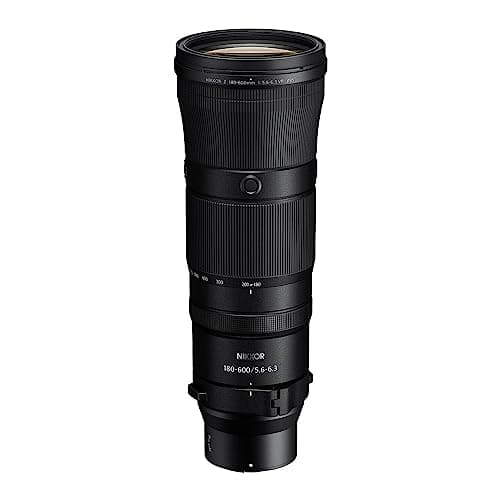

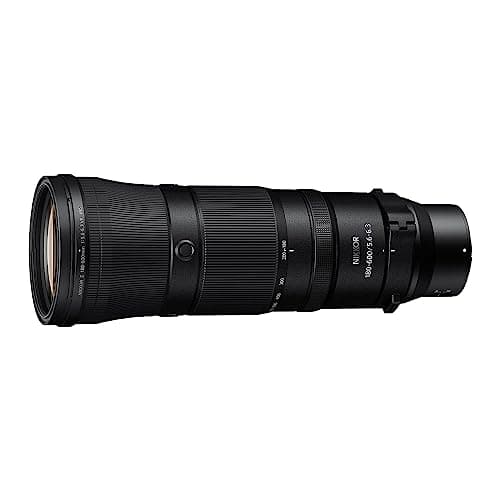
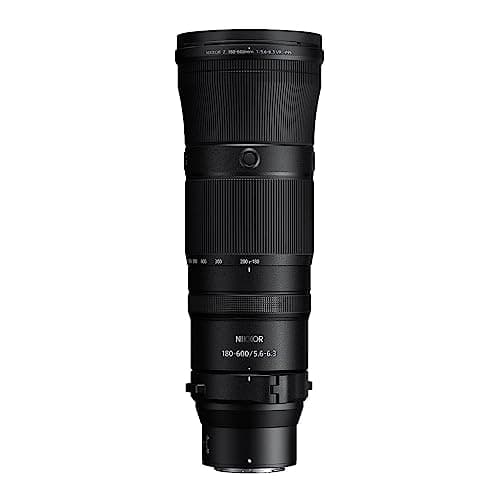
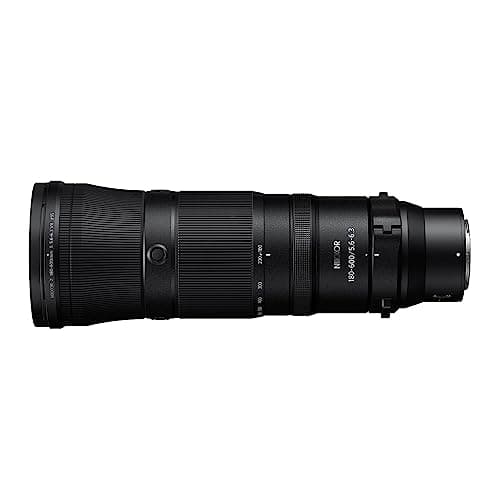
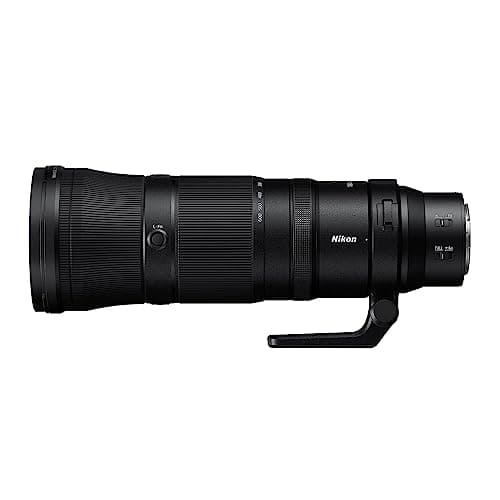
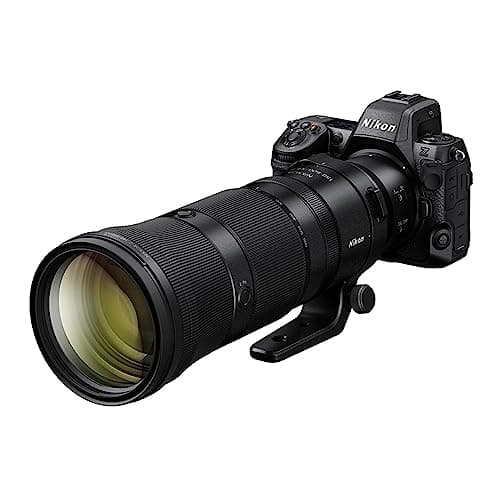

The Nikon Z 180-600mm f/5.6-6.3 VR represents a major milestone in Nikon's full-frame mirrorless lineup.
Introduction
Released as the spiritual successor to the legendary DSLR-era Nikon AF-S 200-500mm f/5.6E ED VR, this lens expands access to super-telephoto reach for the Z-mount system.
Positioned directly between consumer telephotos and exotic, five-figure prime lenses (such as the Nikon Z 400mm f/2.8 TC VR S or Nikon Z 600mm f/4 TC VR S), the Z 180-600mm f/5.6-6.3 VR delivers professional-grade focal versatility at an accessible price point.
Targeted primarily at wildlife, birding, aviation, and field sports photographers, this lens offers a balanced combination of optical performance, internal zoom engineering, and effective image stabilization.
Despite non-S-Line designation, its performance characteristics and feature set make it a foundational optic for both enthusiastic hobbyists and working professionals who demand long-range reach without the physical bulk or cost of ultra-fast prime lenses.
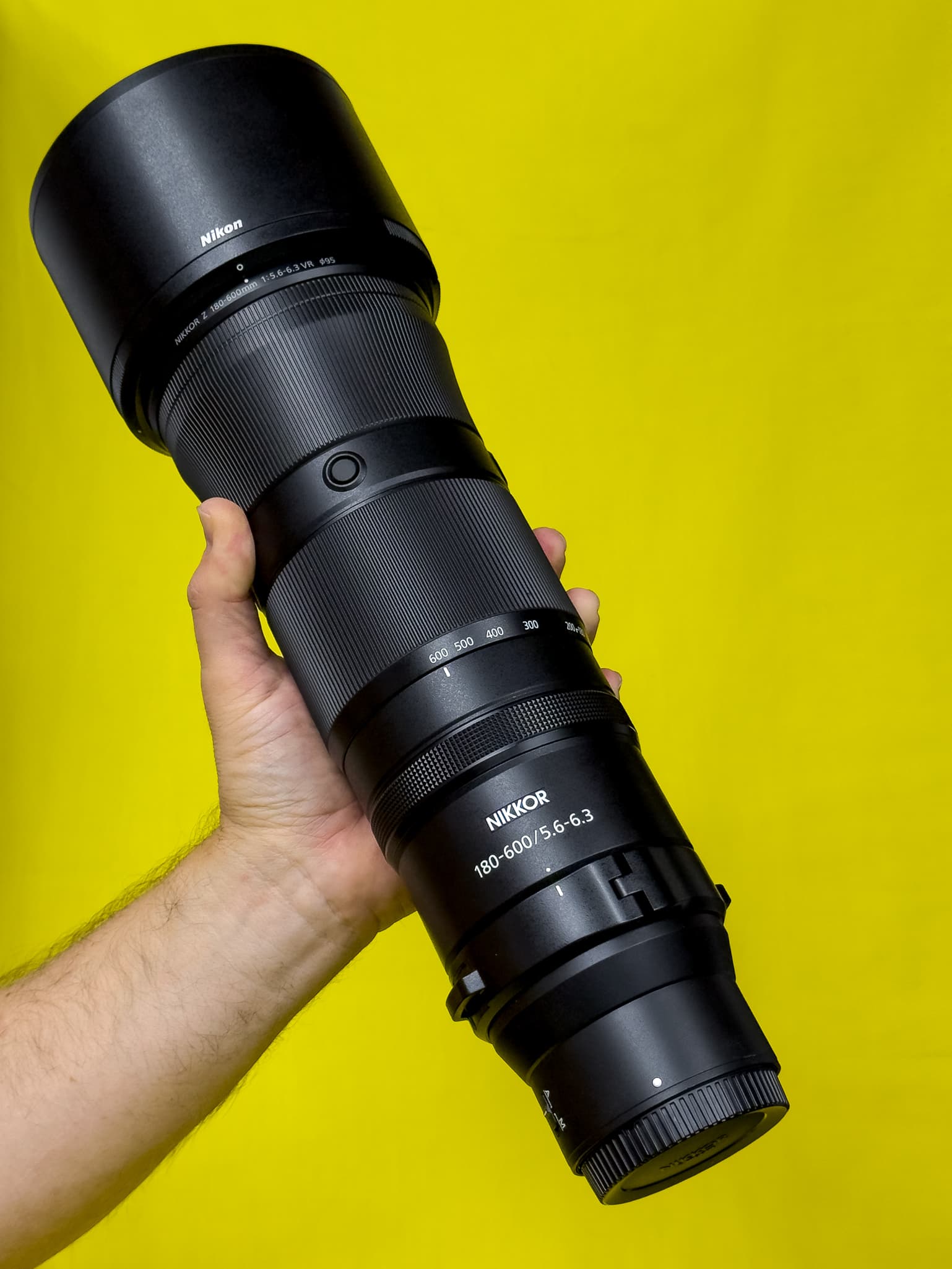
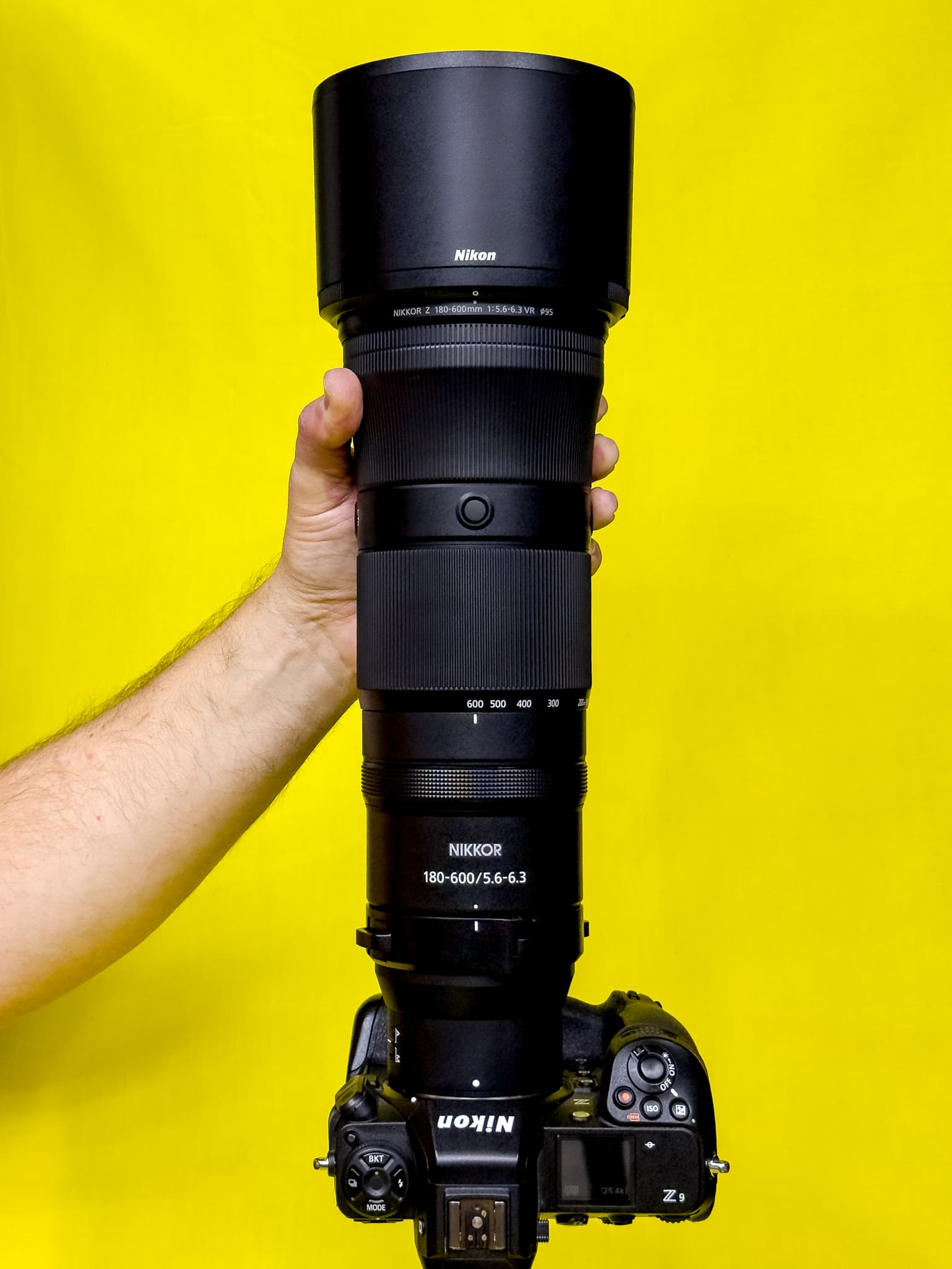
Profile shot of the Nikon Z 180-600mm f/5.6-6.3 VR
1/3Focal Length
The Nikon Z 180-600mm f/5.6-6.3 VR provides a broad 3.33x zoom ratio, expanding the wide end down to 180mm compared to standard 200-600mm designs.
On full-frame (FX) Nikon Z bodies, it offers a diagonal angle of view spanning from 13°40′ at 180mm down to a narrow 4°10′ at 600mm.
When mounted on DX-format (APS-C) bodies such as the Nikon Z50, Nikon Z30, or Nikon Z fc—or when utilized in DX Crop Mode on high-resolution FX sensors like the Nikon Z8 or Nikon Z9, the lens delivers a field of view equivalent to 270-900mm in 35mm terms, with an angle of view ranging from 9° to 2°40′.
This focal envelope offers extreme real-world versatility. At 180mm, photographers can capture environmental portraits of animals, larger field subjects, or wide tracking shots of approaching aircraft.
Rotating the zoom ring to 600mm allows framing for small songbirds, skittish wildlife, or distant sports action without needing digital crop interpolation.
Furthermore, the lens fully supports the NIKKOR Z Teleconverter TC-1.4x and TC-2.0x, transforming the optic into an 840mm f/9 or 1200mm f/13 super-telephoto rig, respectively.


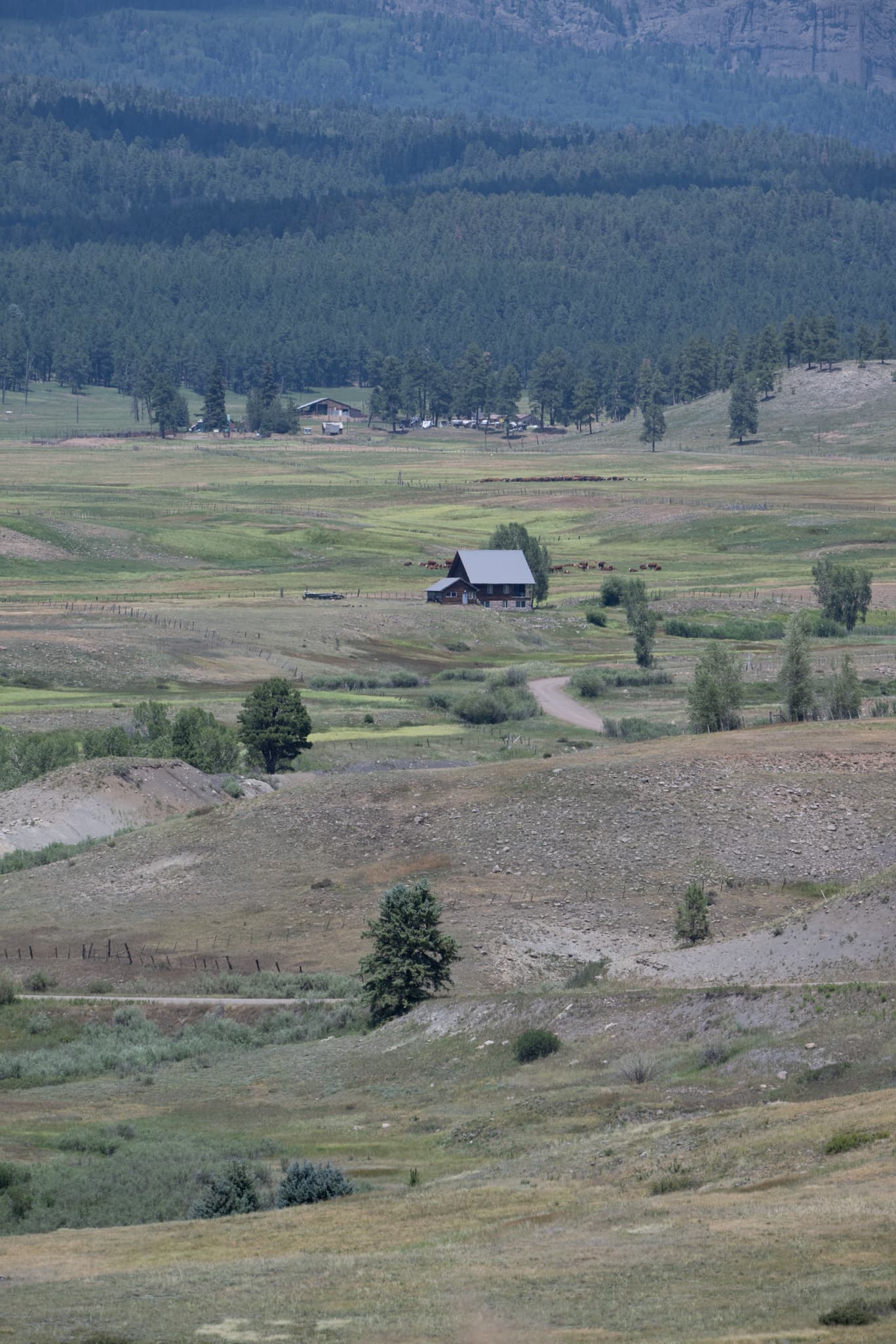



Nikon Z 180-600mm f/5.6-6.3 VR at 180mm at f/8
1/6Aperture
The optical design employs a variable maximum aperture structure, starting at f/5.6 at the wide end and tapering to f/6.3 at maximum focal length.
Nikon engineered fine-grained 1/6-stop transitions across the zoom range:
- 180mm – 290mm: f/5.6
- 300mm – 480mm: f/6.0
- 490mm – 600mm: f/6.3
By maintaining an f/5.6 maximum aperture up through 290mm and delaying the transition to f/6.3 until 490mm, the lens offers a slightly brighter exposure envelope through its mid-range than competing super-telephoto zooms.
The minimum aperture drops down to f/32 at 180mm and f/36 at 600mm.
The aperture diaphragm consists of 9 rounded blades, which maintain a circular aperture opening when stopped down.
This design produces smooth out-of-focus background highlights (bokeh) free from harsh polygonal edges.
Despite the modest f/6.3 light-gathering capacity at the long end, the focal length of 600mm generates shallow depth of field, isolating subjects cleanly from distracting backgrounds.



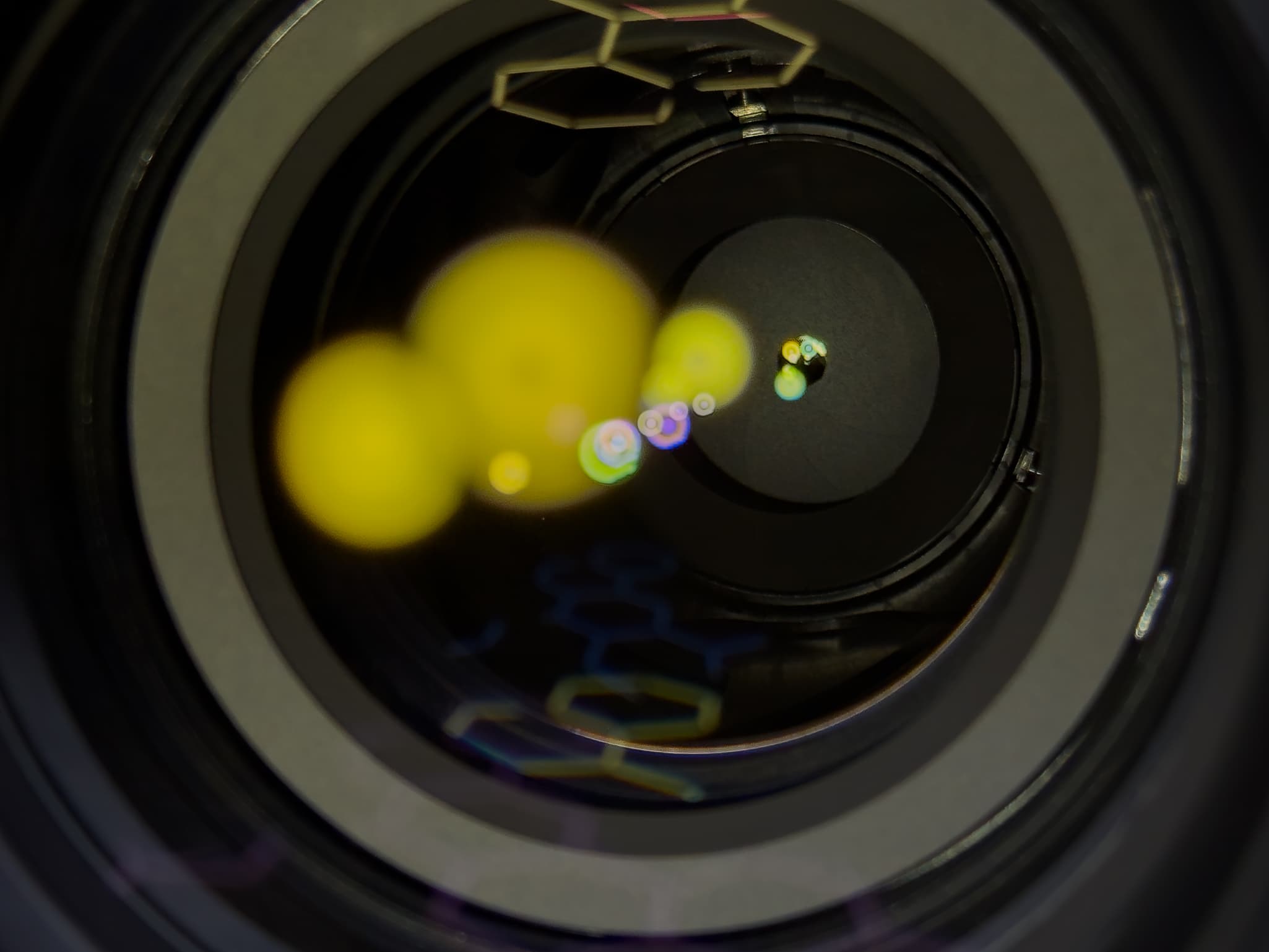
Head-on look at the glass on the Nikon Z 180-600mm f/5.6-6.3 VR
1/4Focus Mechanism
Autofocus is driven by an integrated Stepping Motor (STM) optimized for quiet and precise element movement.
The focus group moves internally, ensuring the physical length of the lens remains unchanged throughout focus operation.
When paired with Nikon's EXPEED 7 processor on bodies like the Nikon Z6 III, Nikon Z8, and Nikon Z9, the STM drive locks onto subjects with low latency and tracks fast, erratic motion—such as birds in flight or field athletes effectively.
The minimum focus distance (MFD) scales with focal length:
- 180mm: 1.3 meters (4.27 feet)
- 200mm: 1.36 meters (4.47 feet)
- 300mm: 1.67 meters (5.48 feet)
- 400mm: 1.94 meters (6.37 feet)
- 500mm: 2.19 meters (7.19 feet)
- 600mm: 2.40 meters (7.88 feet)
At 180mm, the close focus distance yields a maximum reproduction ratio of 0.25x (1:4 magnification), enabling macro-style close-up photography of larger insects, reptiles, and flora.
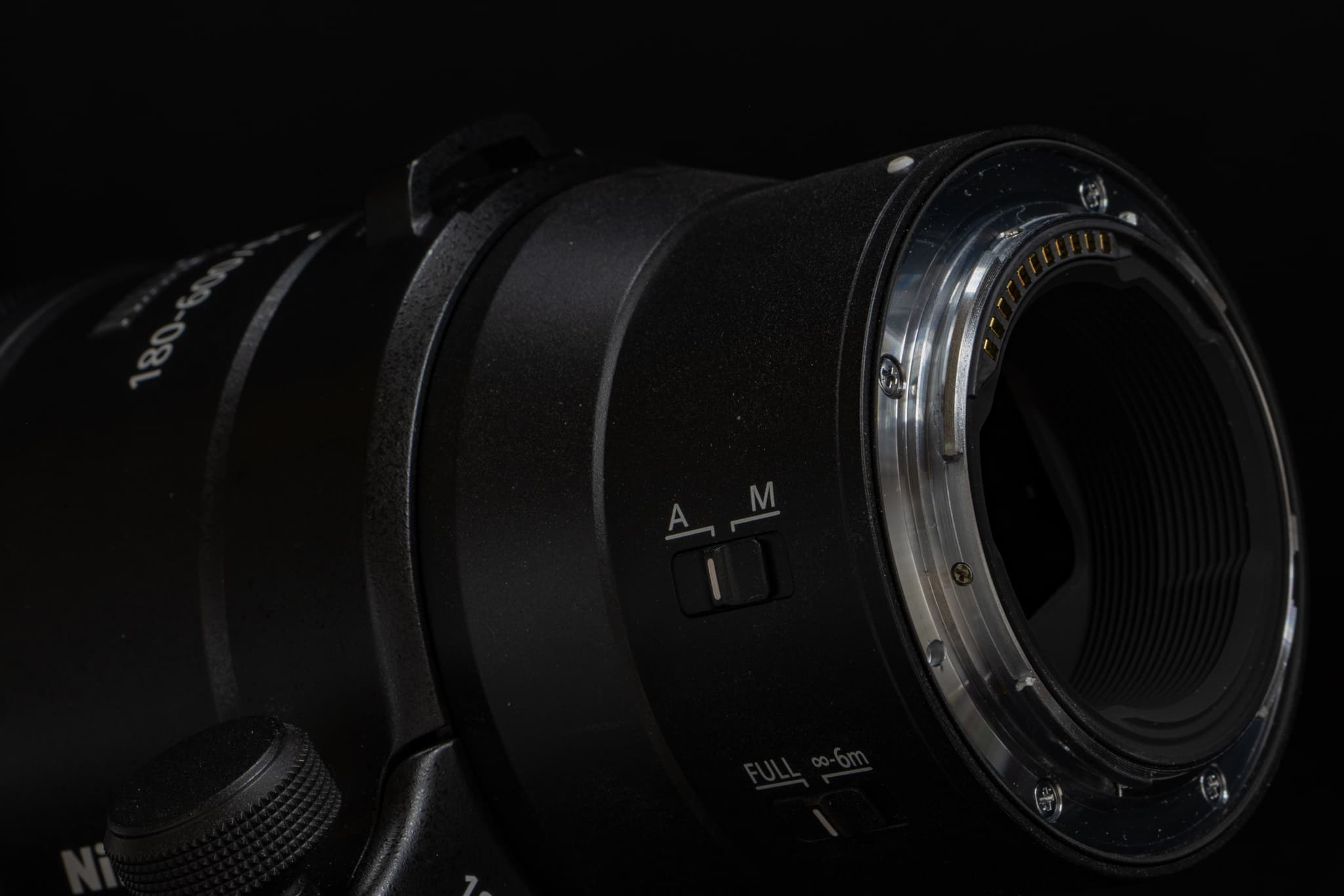
The barrel includes a focus limiter switch with two settings: FULL (1.3m to infinity) and ∞ to 6m.
Engaging the ∞ to 6m limiter prevents the lens from hunting through its close-focus range when tracking distant subjects.
Manual focus override is available via a fly-by-wire focus ring that supports linear or non-linear response modes configured in camera menus.
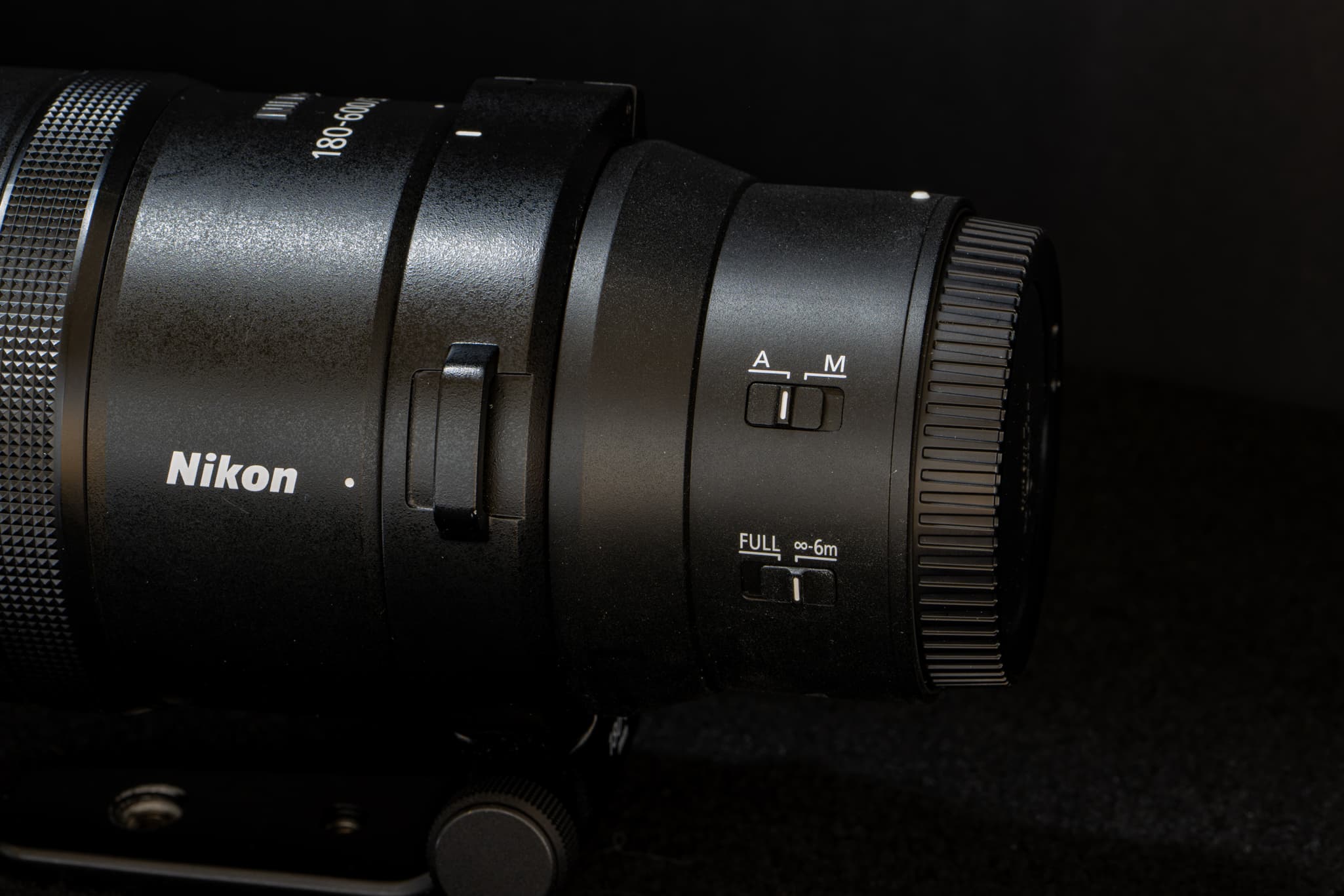
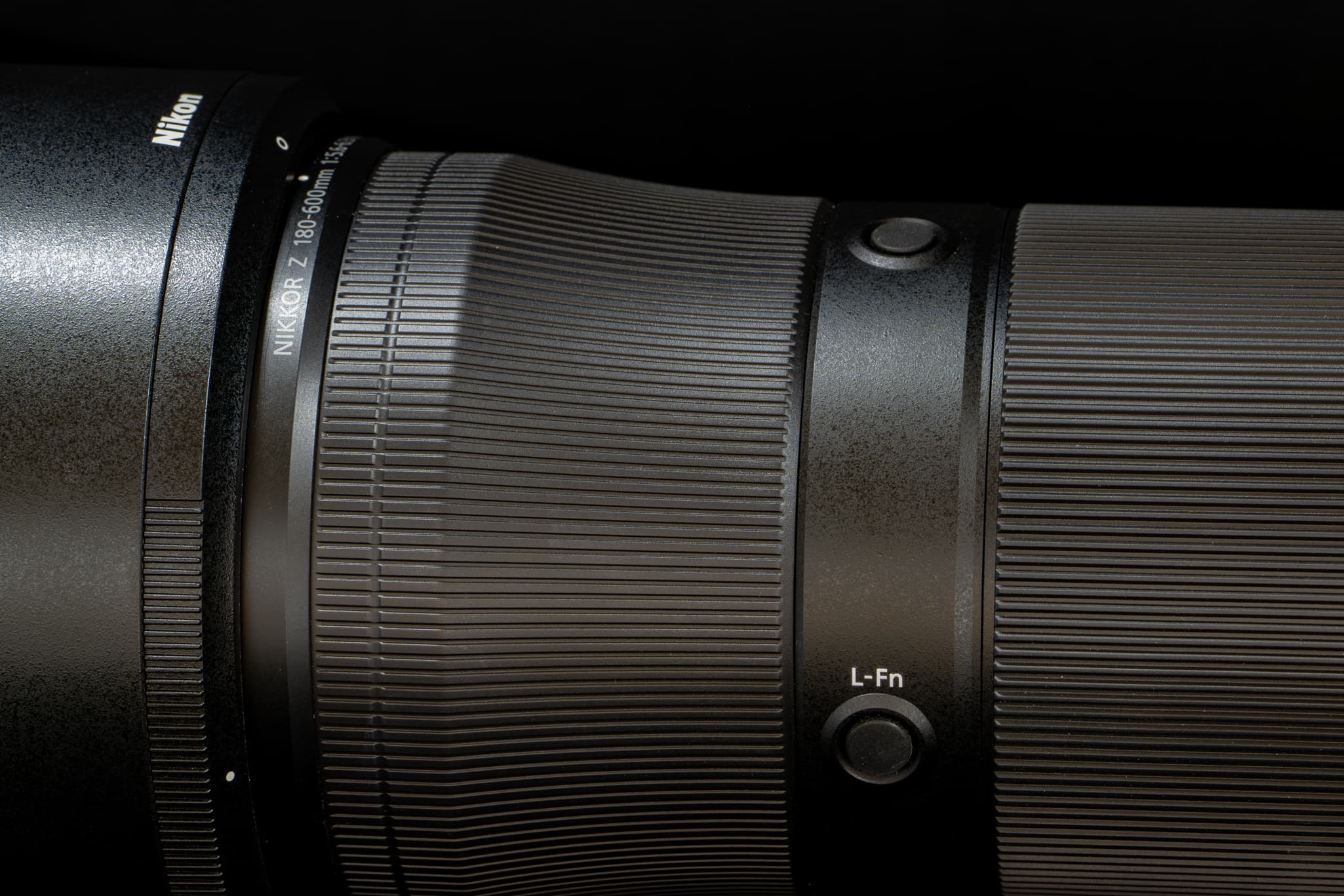
Tactile switch panel on Nikon Z 180-600mm f/5.6-6.3 VR
1/6Optical Design
The optical layout contains 25 lens elements arranged in 17 groups. To minimize optical aberrations across a 3.33x zoom range, Nikon integrated specialized glass formulations:
- 6 ED (Extra-low Dispersion) Elements: Positioned to control chromatic aberrations and axial color fringing, maintaining high contrast along high-contrast borders.
- 1 Aspherical Element: Corrects spherical aberrations, distortion, and field curvature to optimize edge-to-edge sharpness.
Anti-reflective performance is handled by Nikon's Super Integrated Coating (SIC), which mitigates ghosting and internal flare when shooting toward strong light sources.
While it lacks the high-end Nano Crystal, ARNEO, or Meso Amorphous coatings found on S-Line glass, flare suppression remains well-managed for a broad-range telephoto zoom.
Optically, lateral chromatic aberration is low; while minor fringing appears in the far corners at 180mm, it vanishes almost completely above 300mm.
Pincushion distortion measures around 1.1% in raw files at mid-range focal lengths, but in-camera profiles and RAW converter corrections eliminate it completely.






High-angle shot of the front glass element of the Nikon Z 180-600mm f/5.6-6.3 VR
1/7Construction Materials
The exterior of the Nikon Z 180-600mm f/5.6-6.3 VR features high-grade, impact-resistant polycarbonate over a durable internal metal frame.
A key mechanical highlight is its internal zoom mechanism—the overall physical length remains fixed at 315.5 mm (12.5 inches) regardless of focal length setting.
Control surfaces are logically organized along the barrel:
- Zoom Ring: Features a wide rubberized grip with a short 70-degree rotation throw from 180mm to 600mm, allowing quick focal adjustments without shifting hand placement.
- Control Ring: A clickless, customizable ring positioned near the mount, assignable to manual focus, aperture control, ISO selection, or exposure compensation.
- L-Fn Buttons: Four customizable Function (L-Fn) buttons are positioned at 90-degree increments around the front grip, enabling accessible control activation regardless of shooting orientation.
- Physical Switches: Tactile switches for AF/MF mode selection and Focus Limiter setting (FULL vs. ∞–6m).
The front barrel accepts 95mm screw-in filters. The rear features a solid, precision-machined metal Z-mount bayonet. It comes standard with a removable, rotating tripod collar featuring strap eyelets and standard threaded mounts.
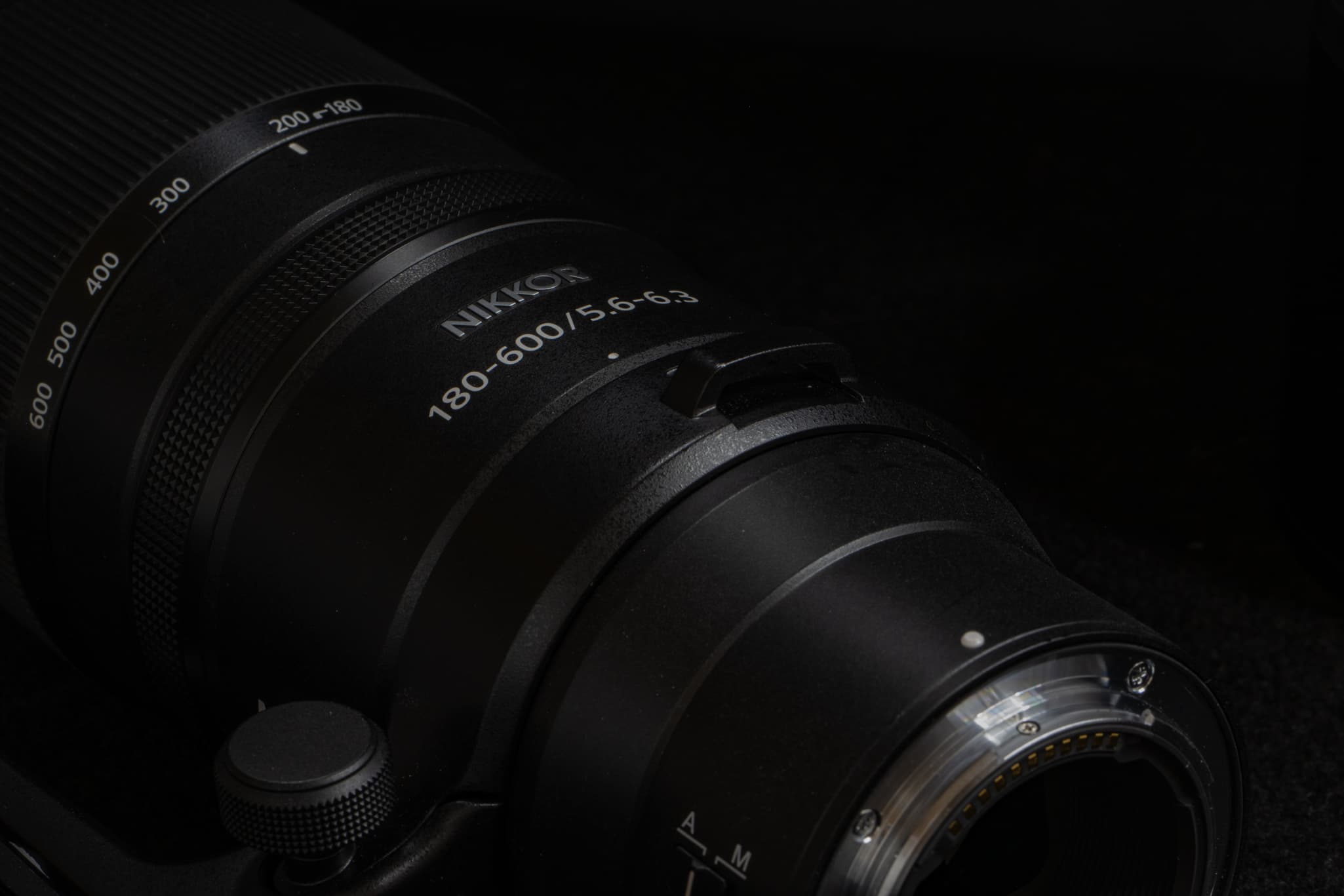
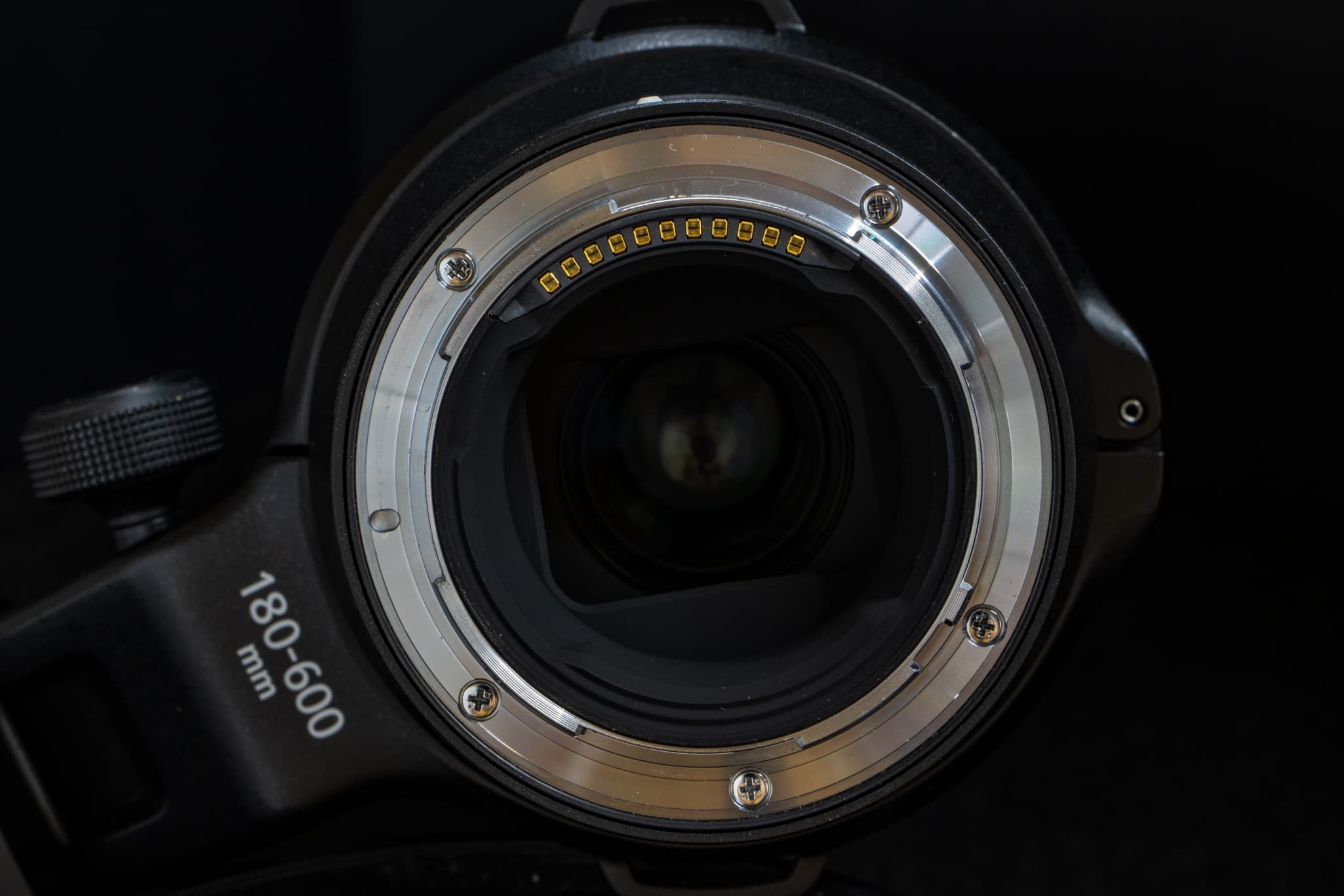
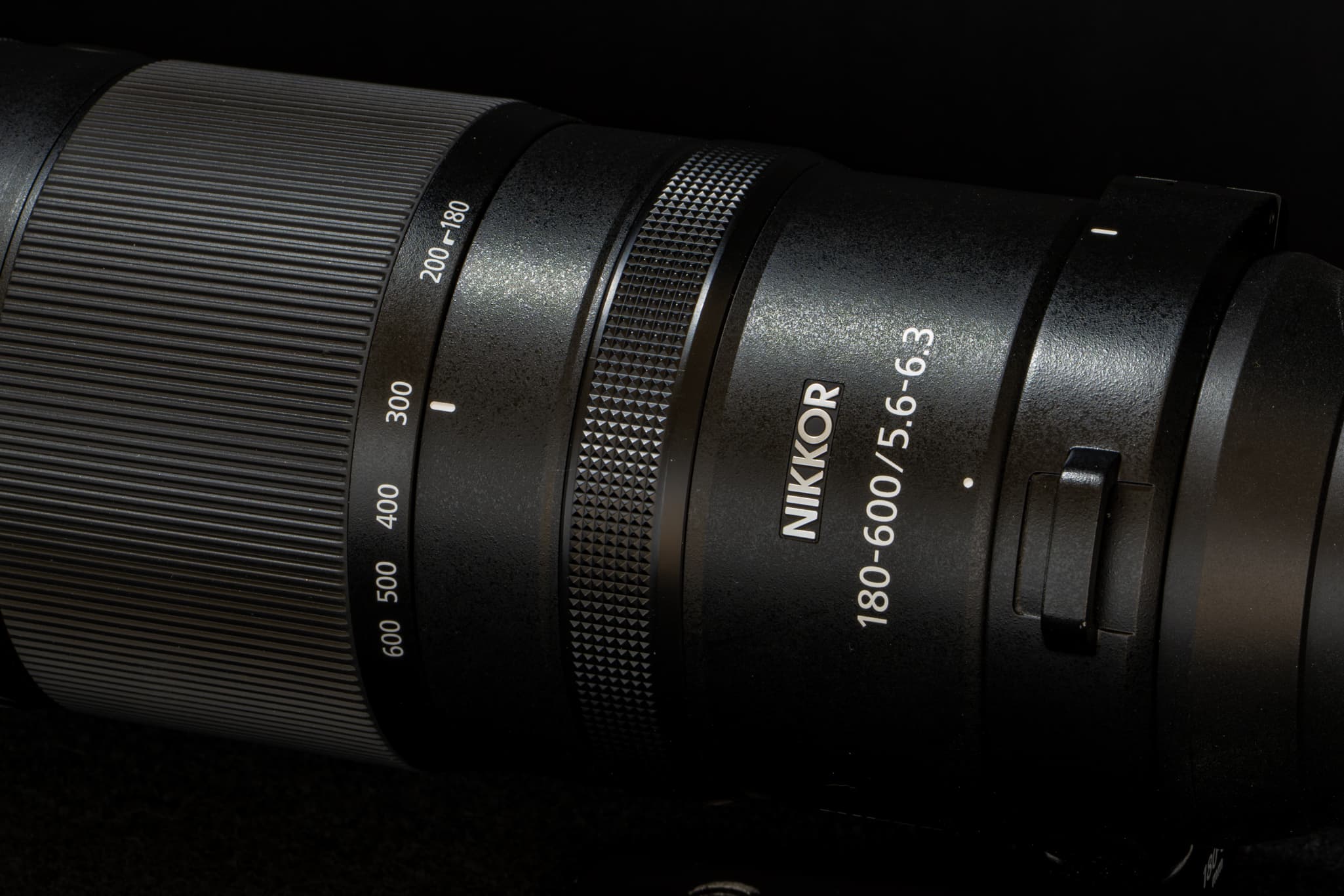
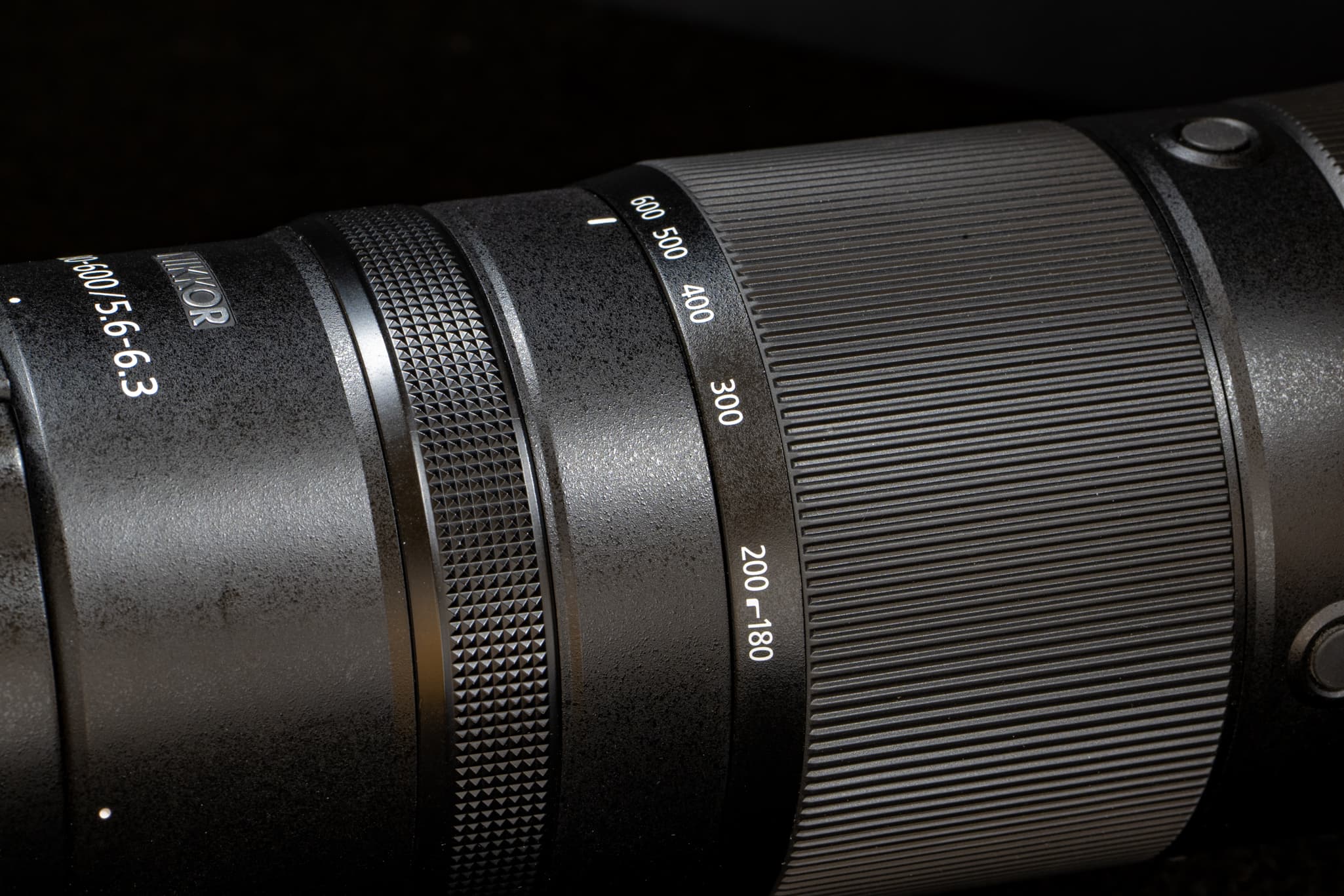
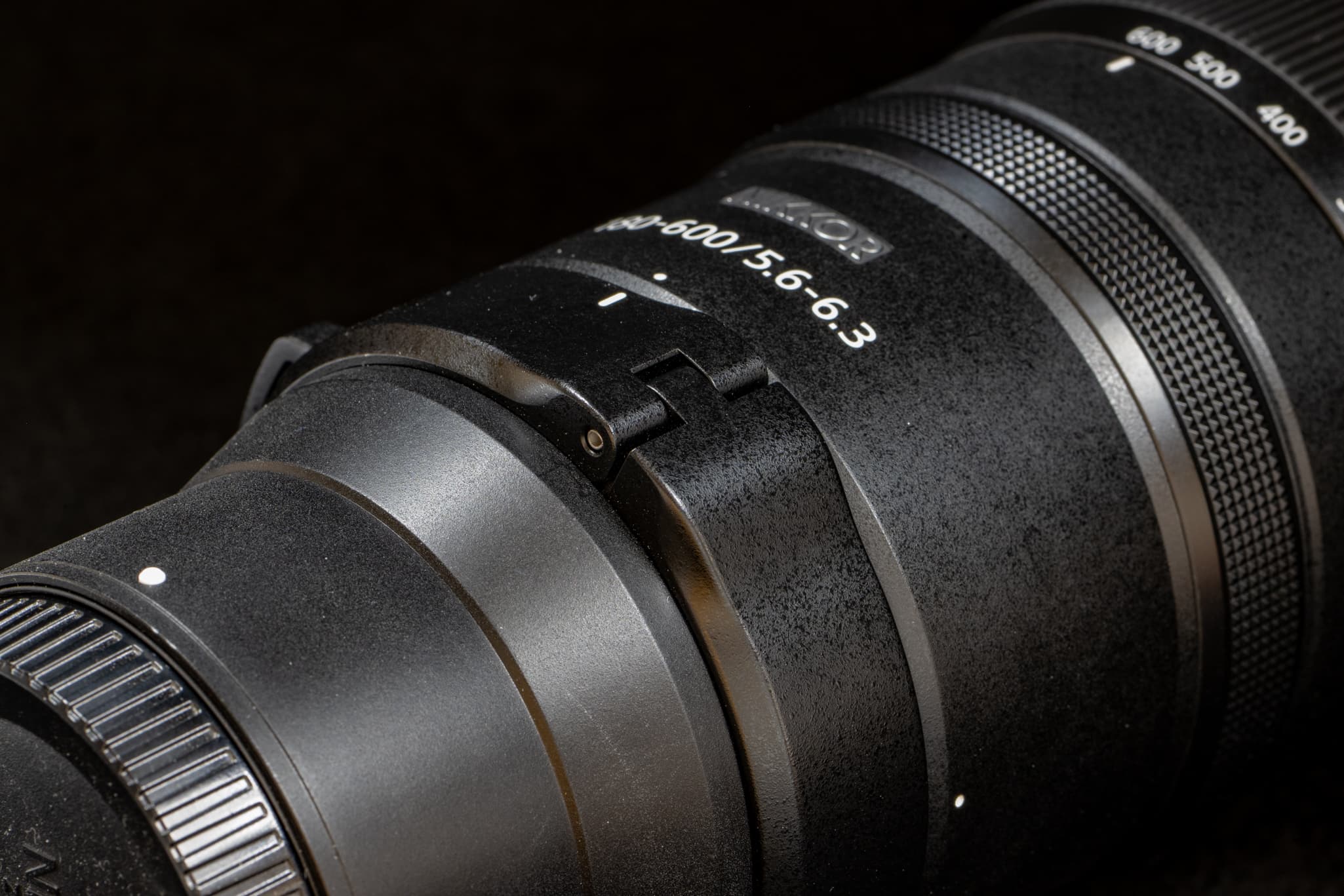
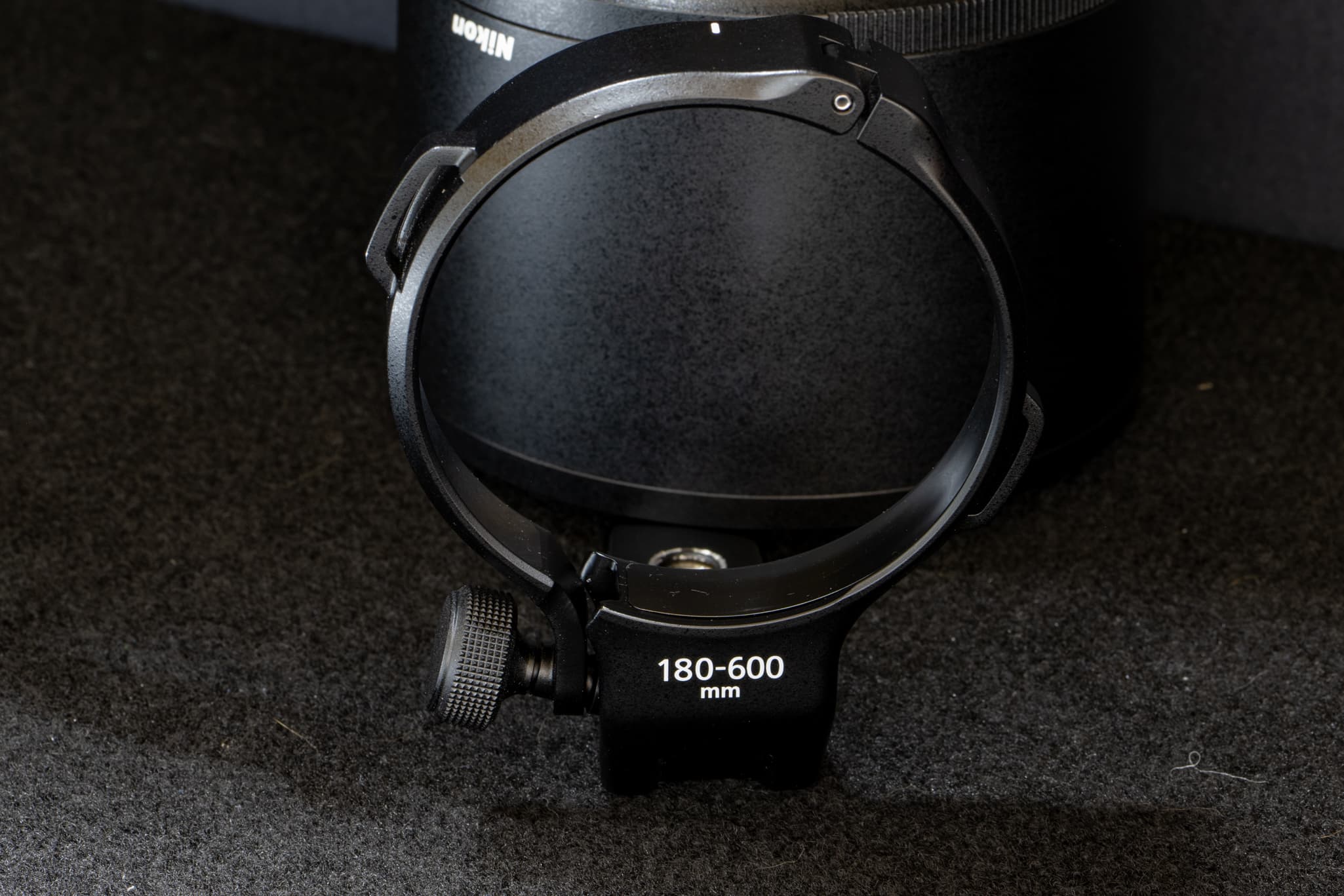
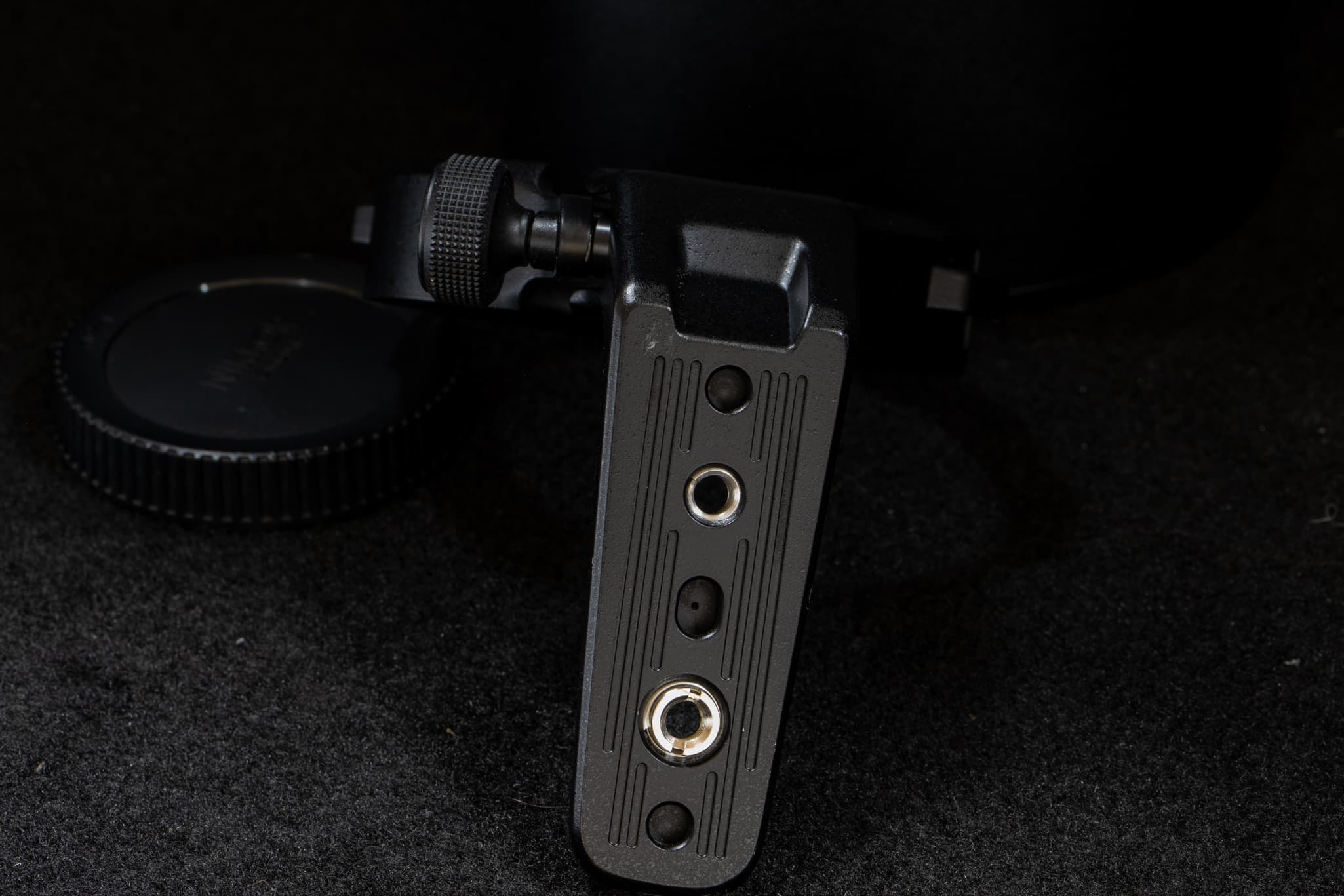
Highlighting the material design on the Nikon Z 180-600mm f/5.6-6.3 VR
1/9Weather-Sealing
The lens includes internal dust and moisture protection designed for adverse outdoor conditions.
Synthetic rubber gaskets seal every moving joint, control ring, switch panel, and the lens mount interface.
The internal zoom design provides a structural weather-sealing advantage: because the front housing does not extend or retract, the lens does not create a vacuum effect that pulls dust, moisture, or airborne humidity into the optical barrel.
The exposed front glass element features a fluorine coating. This layer repels oil, moisture, fingerprints, and dirt, making the surface easier to clean without damaging anti-reflective layers.
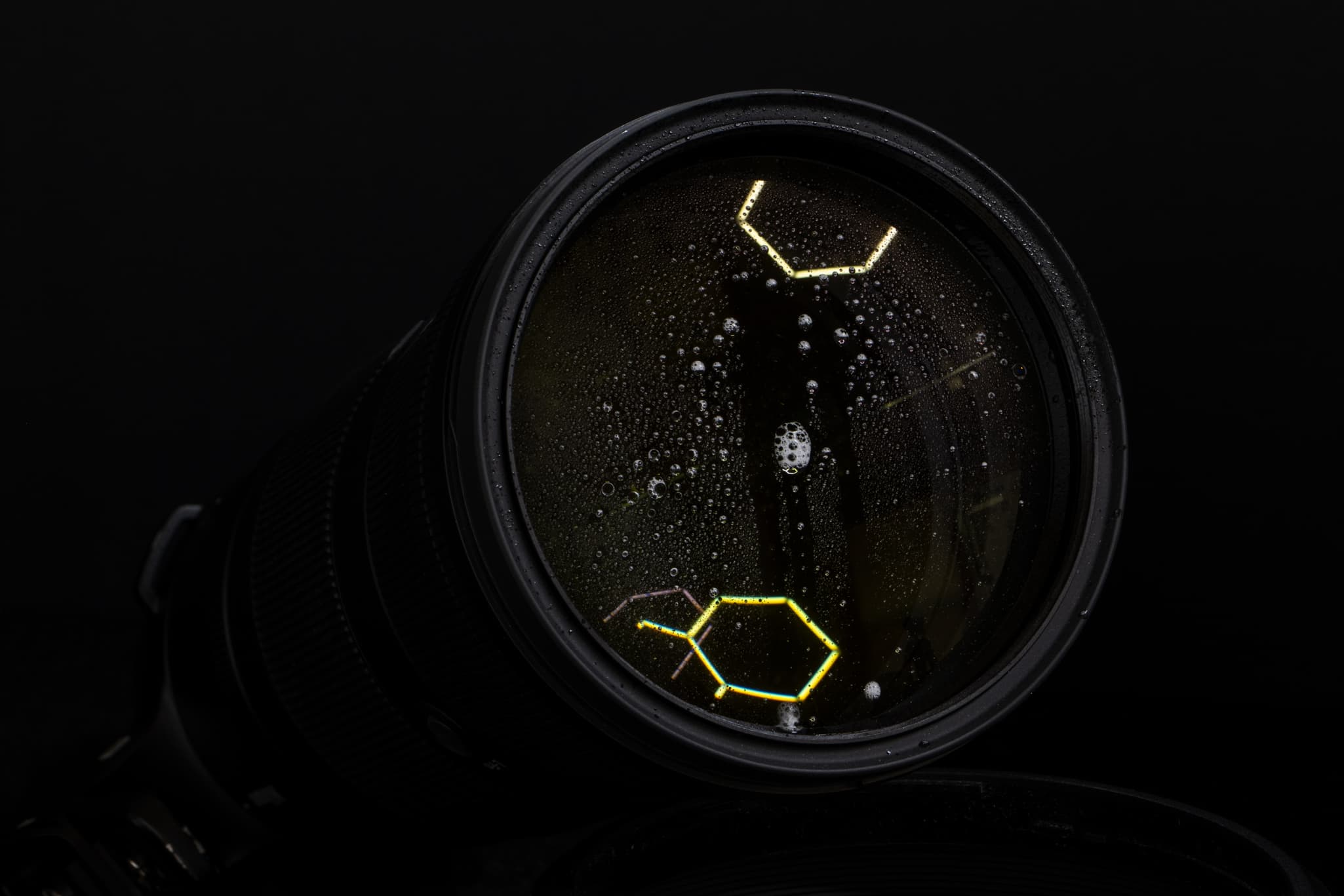
Close-up focusing on the black rubber weather-sealing gasket lining of the Nikon Z 180-600mm f/5.6-6.3 VR
1/2Weight
The physical weight of the NIKKOR Z 180-600mm f/5.6-6.3 VR is balanced relative to its focal reach:
- Bare Lens Weight (without collar): 1,955 grams (4 lbs, 5.0 oz / 4.31 lbs)
- Total Operating Weight (with tripod collar): 2,140 grams (4 lbs, 11.5 oz / 4.72 lbs)
Because zooming takes place internally, the center of gravity stays balanced during focal adjustments.
This mechanical stability prevents front-heavy tipping, making extended handheld tracking comfortable when mounted on full-size professional camera bodies like the Nikon Z8 or Nikon Z9. On smaller Z bodies, using a battery grip helps balance the setup during long shooting sessions.
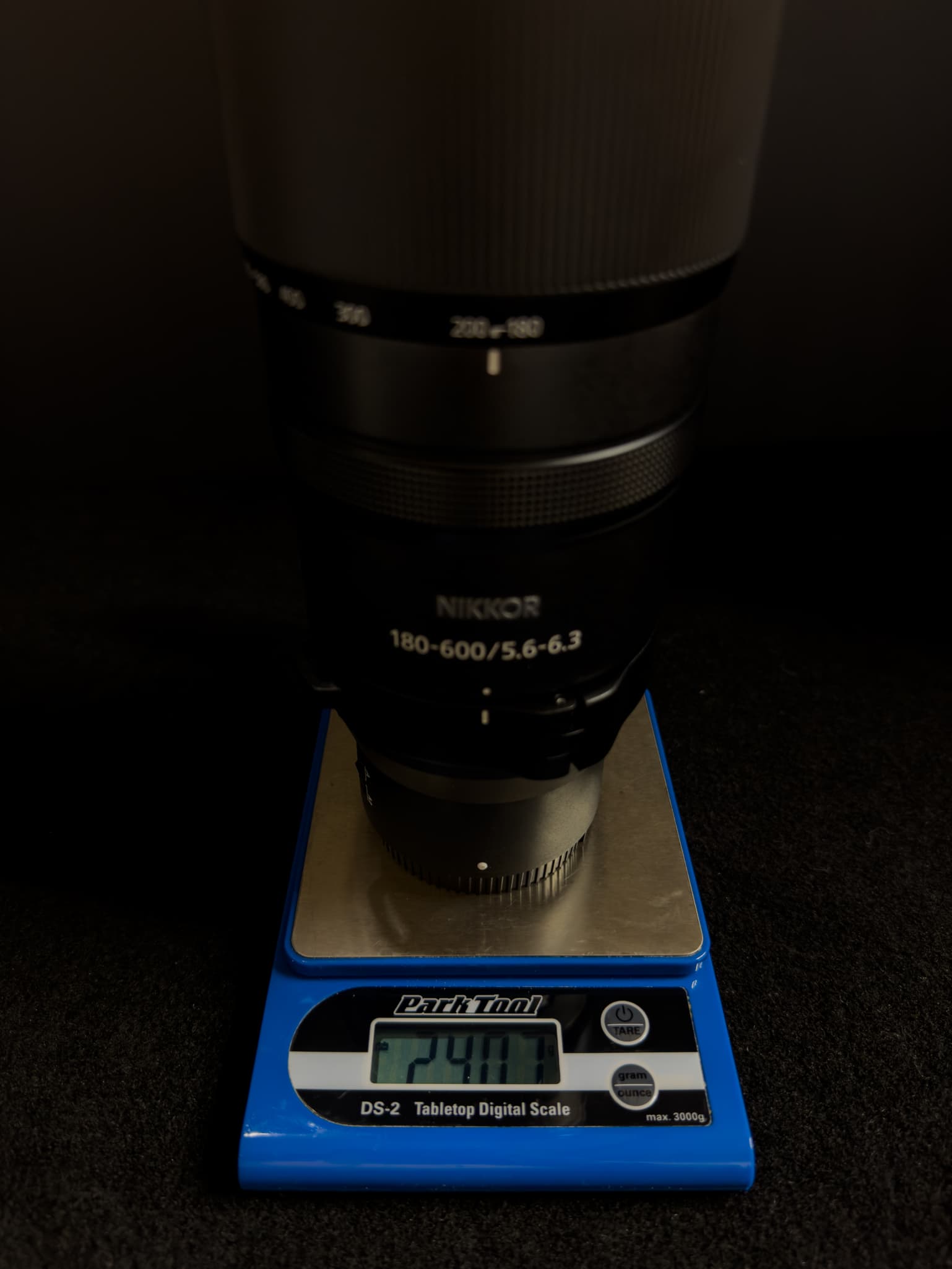
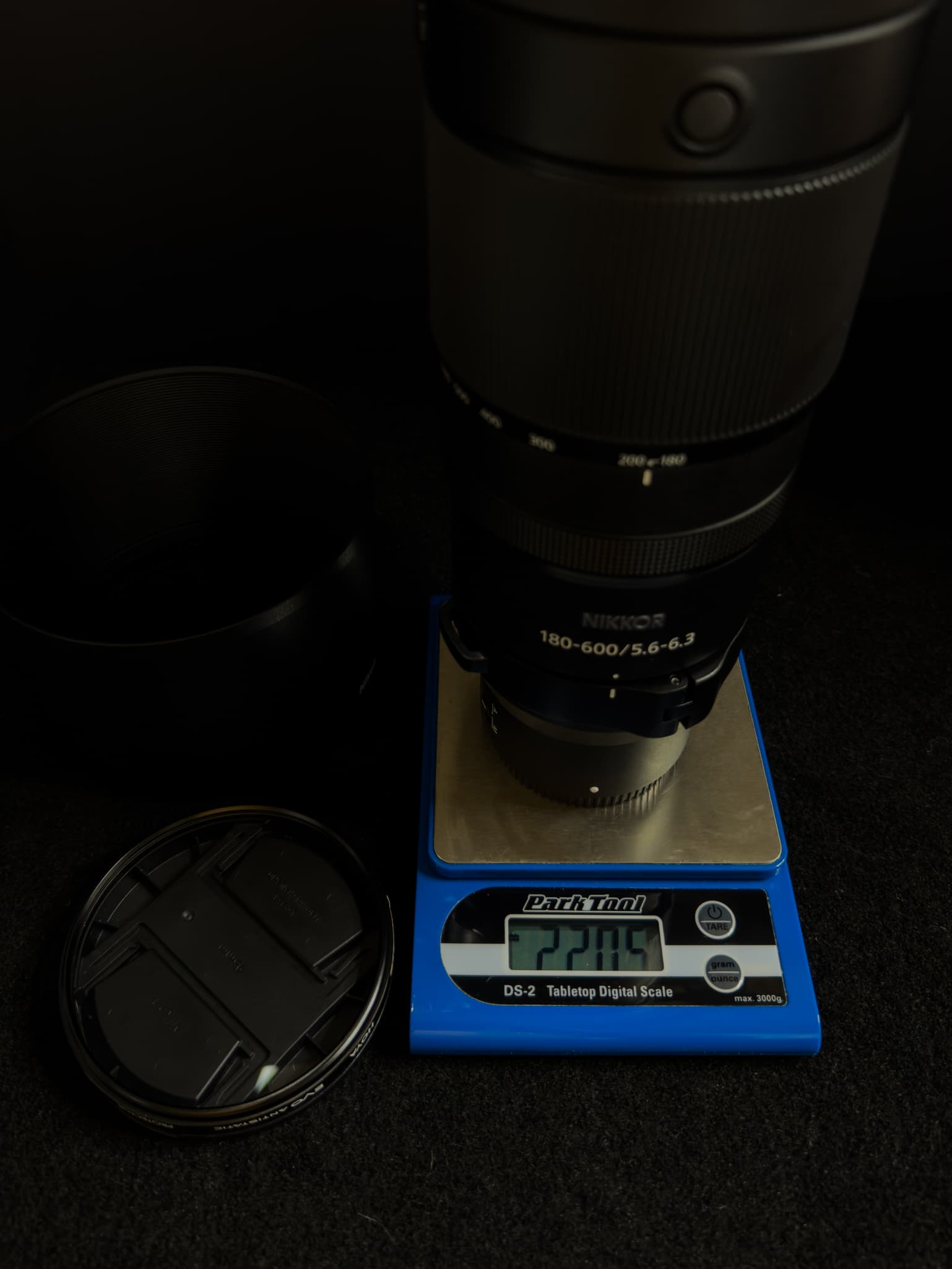
Weight of Nikon Z 180-600mm f/5.6-6.3 VR with lens cap
1/2Image Stabilization
The optical Vibration Reduction (VR) system utilizes lens-shift technology driven by voice coil motors (VCMs) to compensate for camera movement.
- Stabilization Rating: Rated for up to 5.5 stops of compensation according to CIPA standards.
- Operating Modes: Features two selectable modes via camera menus—Normal for static handheld shooting and Sport for tracking fast, erratically moving subjects with a stable viewfinder image.
When attached to full-frame Z bodies equipped with In-Body Image Stabilization (IBIS), the lens VR coordinates with the camera sensor stabilization across pitch, yaw, roll, and translational axes.
In real-world handheld testing at 600mm, sharp exposures can be maintained at shutter speeds as low as 1/30s to 1/60s with good technique, reducing reliance on elevated ISO settings in low-light environments.
Testing image stabilization with first half showing Optical VR and then second half turning it off Nikon Z 180-600mm f/5.6-6.3 VR
Image Quality
For landscape photography, it delivers high contrast, rich micro-detail, and neutral color rendering across distant mountain ranges, geological formations, and horizon framing.








Landscape photography with the Nikon Z 180-600mm f/5.6-6.3 VR
1/8For wildlife photography, it excels due to its ability to photograph subject from far away with detail





Wildlife photography with the Nikon Z 180-600mm f/5.6-6.3 VR
1/5For macro photography, it is highly versatile due to its 0.25x reproduction ratio at 180mm (MFD of 1.3 meters). Ideal for photographing dragonflies, butterflies, flowers, and small reptiles from a comfortable working distance.



Macro photography with the Nikon Z 180-600mm f/5.6-6.3 VR
1/3For low light photography, it is constrained by the f/5.6-6.3 aperture envelope. Shooting under low light requires high-ISO capable camera sensors (such as the Z6 III, Z8, or Z9) or slower shutter speeds utilizing the VR system.

Low light photography with the Nikon Z 180-600mm f/5.6-6.3 VR
For street photography, it is capable of capturing distant candid details, though its physical length (315.5 mm) makes it noticeable in urban environments.
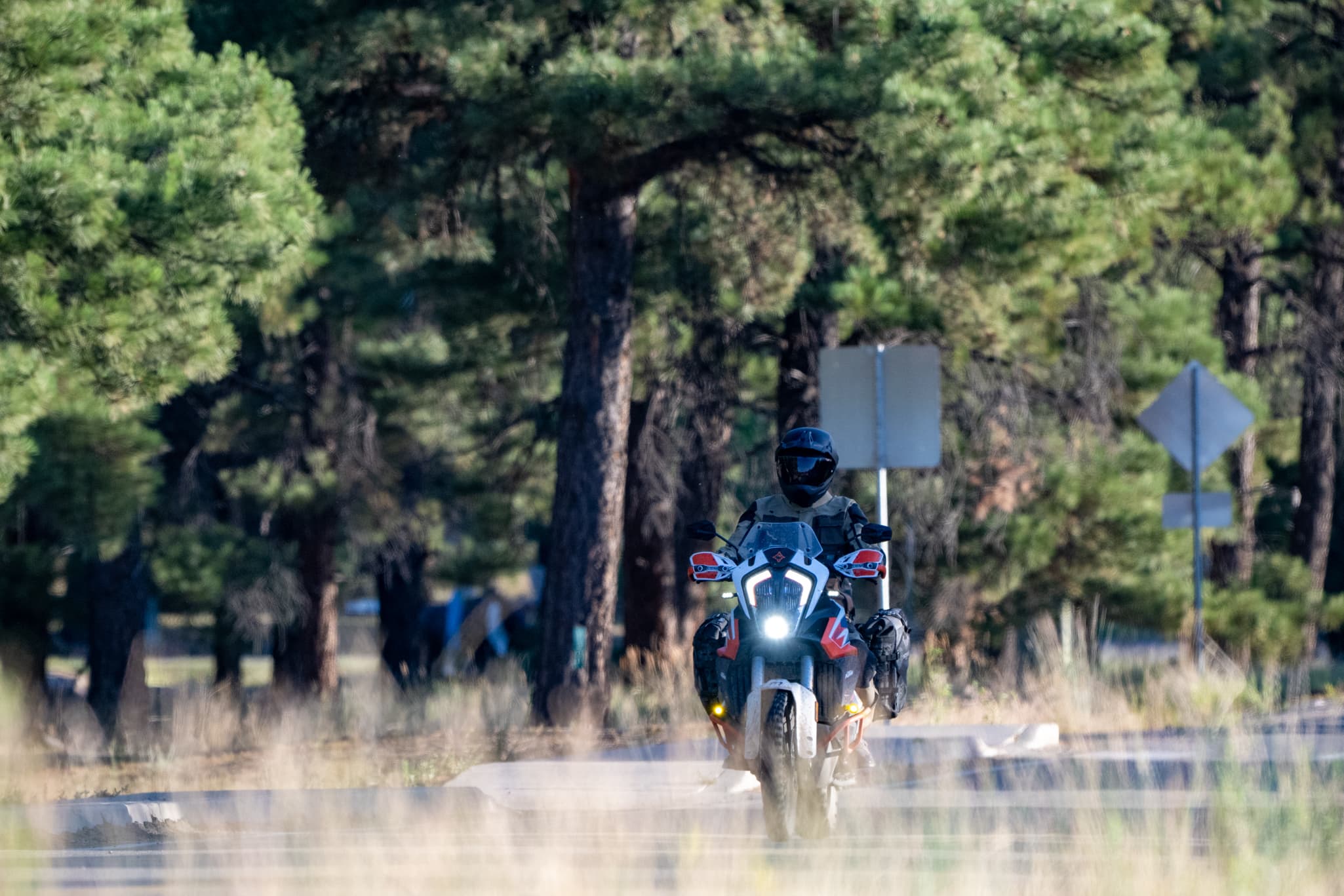


Street photography with the Nikon Z 180-600mm f/5.6-6.3 VR
1/3F-Stop Ranges
Optical performance across the f-stop spectrum reveals well-managed resolution metrics:
- f/5.6 – f/6.3: Center resolution is sharp across the entire focal range. At 600mm f/6.3, the center remains crisp, while the far edges show light contrast falloff and minor corner vignetting (around 0.7 EV raw), which is easily managed by in-camera profile corrections.
- f/8: Stopping down to f/8 yields maximum optical performance. Edge-to-edge resolution unifies, micro-contrast peaks, and corner vignetting is eliminated. This is the recommended aperture setting for landscape and detailed nature work.
- f/11: Resolution remains solid across the frame. While high-resolution sensors (such as 45.7MP on the Z8/Z9) show early diffraction, images retain high detail with minor sharpening in post-production.
- f/16: Diffraction causes noticeable softening across fine-detail structures. Contrast drops slightly, though it remains usable if extended depth-of-field is necessary.
- f/22 to f/36: Optical diffraction significantly degrades fine detail. These minimum apertures should be avoided unless maximum depth-of-field takes priority over peak resolution.



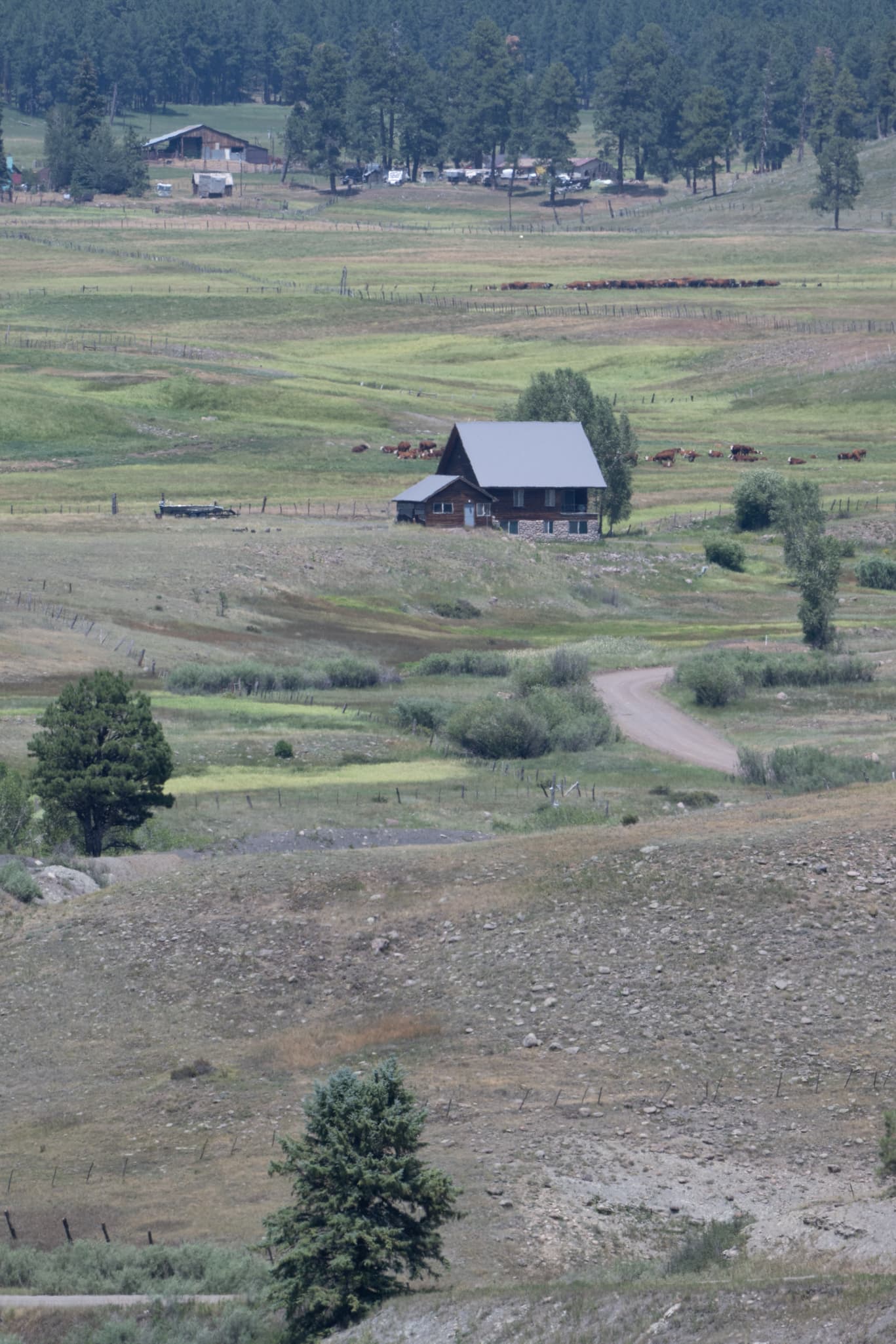

Nikon Z 180-600mm f/5.6-6.3 VR at 600mm at f/6.3
1/5Video Quality
The Nikon Z 180-600mm f/5.6-6.3 VR is well-suited for video applications, particularly for nature documentarians, sports cinematographers, and videographers needing telephoto compression.
- Focus Breathing Control: Optical focus breathing is heavily suppressed. Rack-focus transitions between foreground and background subjects maintain framing without noticeable focal-length shifts.
- Acoustic Noise: The internal STM motor operates silently, preventing drive noise from leaking into on-board audio equipment during continuous tracking.
- Iris Adjustments: The customizable control ring allows for smooth, clickless aperture adjustments during recording, eliminating exposure stepping artifacts.
- Gimbal & Fluid Head Balance: The internal zoom system maintains constant physical dimensions and internal weight distribution. Videographers can zoom from 180mm to 600mm without re-balancing fluid heads or motorized gimbals.
Conclusion
The Nikon Z 180-600mm f/5.6-6.3 VR is a versatile, high-performing super-telephoto zoom lens for the Nikon Z system. By combining an extended 180-600mm focal range, internal zoom architecture, reliable autofocus tracking, and 5.5 stops of optical stabilization into an accessible package, Nikon has produced an outstanding option for action, sports, and wildlife photographers.
Buy it if:
- You need super-telephoto reach (up to 600mm natively) for wildlife, birding, sports, or aviation photography on a budget.
- You prefer internal zoom lenses that keep fixed physical dimensions and stable weight distribution when mounted on gimbals or fluid heads.
- You want a responsive zoom mechanism with a short 70-degree rotation throw.
- You require close-focusing capabilities, taking advantage of its 0.25x macro magnification at 180mm.
- You shoot in harsh outdoor environments and need robust weather-sealing paired with a fluorine-coated front element.
Skip it if:
- You shoot primarily in low-light environments and require a constant f/2.8 or f/4 maximum aperture.
- You need a lightweight, ultra-compact handheld setup for casual travel or street photography.
- You require native Arca-Swiss compatibility out of the box without purchasing an aftermarket tripod foot.
- You demand absolute peak prime-lens resolution at f/4 or f/5.6 and have the budget for exotic Z-mount prime glass.
Description
The Nikon Nikkor Z 180-600mm F5.6-6.3 VR is a powerful super-telephoto zoom lens designed for Nikon Z-series mirrorless cameras, offering exceptional reach and performance for wildlife, sports, and bird photographers. With a zoom range of 180-600mm, this lens allows you to capture distant subjects with impressive detail, whether you're photographing fast-moving animals or athletes in action. The variable aperture of f/5.6-6.3 ensures a balance between portability and performance, while the built-in Vibration Reduction (VR) system minimizes camera shake, ensuring sharp, stable images even when shooting handheld at longer focal lengths. Advanced optical elements help to reduce chromatic aberration and distortion, providing high-contrast, high-resolution images with excellent color accuracy. The lens features fast and precise autofocus, making it ideal for both stills and video work. Its rugged, weather-sealed construction ensures reliability in harsh environments, and its relatively lightweight design makes it easier to handle compared to other lenses in its class. Whether you’re capturing wildlife in the field or sporting events, the Nikon Nikkor Z 180-600mm F5.6-6.3 VR delivers exceptional performance and versatility, making it a must-have tool for serious photographers seeking a long-range, high-quality zoom lens.
Sample Photos
Sample photos will be added soon!
Basics
| Name | Nikon Z 180-600mm F5.6-6.3 VR |
|---|---|
| Release Date | June 2023 |
| Brand | Nikon |
| Type |
|
| Focal Length | 180-600mm |
| Prime or Zoom | Zoom |
| Max Format Size | 35mm FF |
| Diaphragm Blades | 9 |
| Lens Elements | 25 |
| Lens Groups | 17 |
| Filter Thread | 95mm |
| Lens Hood Supplied | Yes |
| Tripod Collar | Yes |
| Lens Coating | |
| Weather-Sealing | Yes |
| Color | Black |
| Lens Mount |
|
Autofocus
| Autofocus | Yes |
|---|---|
| Motor Type | Stepper motor |
| Focus Method | Internal |
| Minimum Focus | 1.30 m (51.18″) |
| Max Magnification | 0.25× |
Aperture
| Maximum Aperture | f5.6 |
|---|---|
| Minimum Aperture | f36 |
| Aperture Ring |
Features
| Features |
|
|---|
Dimensions & Weight
| Weight | 2140 g (4.72 lb) |
|---|---|
| Diameter | 110 mm (4.33″) |
| Length | 316 mm (12.44″) |
Use Case
| Use Cases |
|
|---|
Experience Level
| Experience Level | Amateur, Professional |
|---|
* Product prices and availability are accurate as of the date/time indicated and are subject to change. Any price and availability information displayed on Amazon.com at the time of purchase will apply to the purchase of this product. Imaginated.com may receive compensation for purchases made at participating retailers linked on this site. This compensation does not affect what products or prices are displayed, or the order of prices listed. Learn more here.